Stop Adding Features to Your Product Page. Start Removing Buyer Doubts
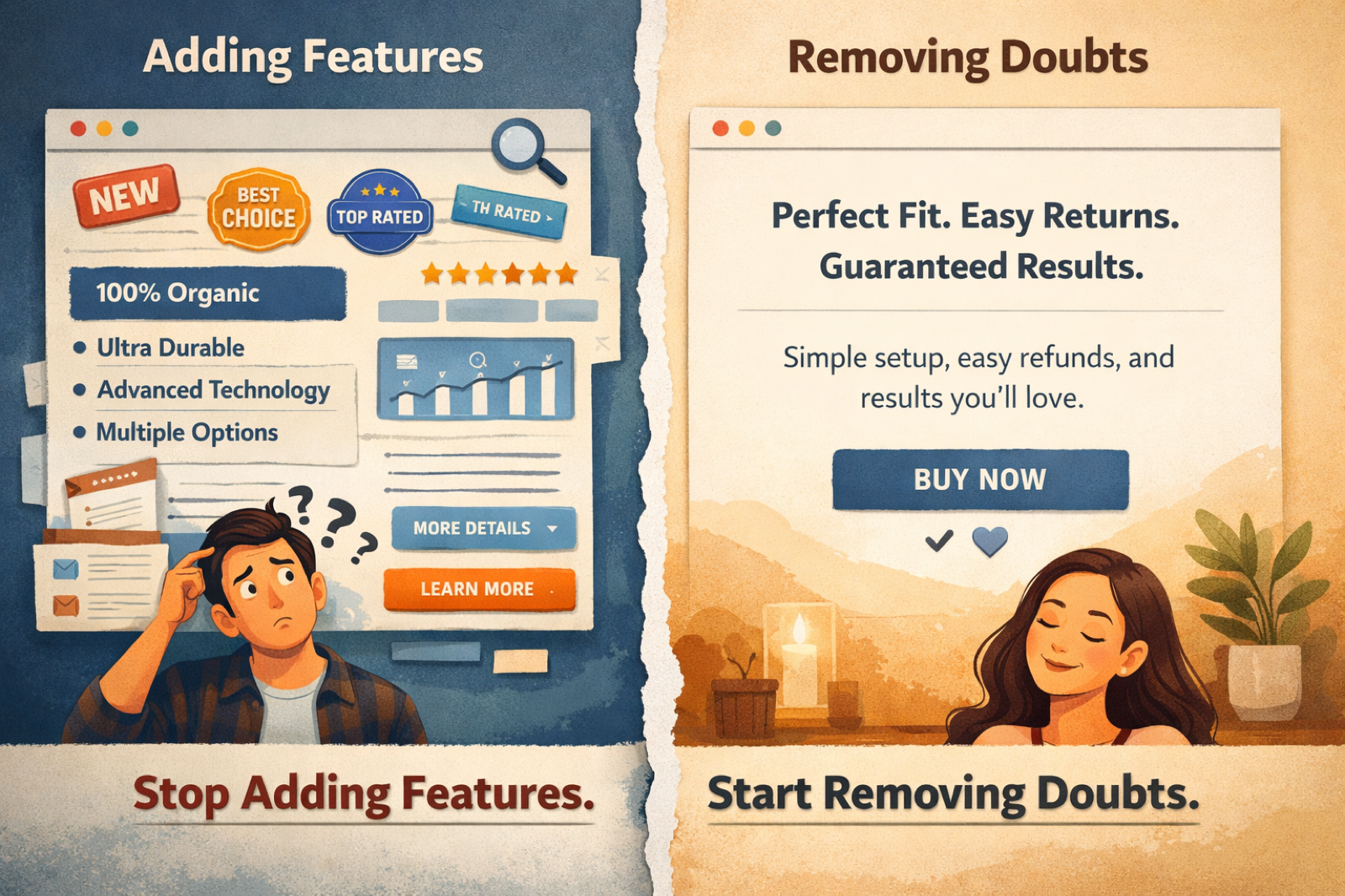
When conversions drop, most Shopify merchants reach for the same lever. They add another feature, another badge, another section explaining why the product is good. The page grows longer. The layout gets denser.
But conversion problems rarely come from missing information. They come from unresolved hesitation. A buyer does not leave your product page thinking, "I wish this had one more feature." They leave thinking, "I am not fully sure." That uncertainty is the real enemy of conversion.
Features Explain. Objections Decide.
Features are descriptive. Objections are emotional.
A feature tells the buyer what the product is. An objection determines whether the buyer feels safe buying it.
Most product pages are built like documentation: what it is made of, what it includes, what it does. Very few are built like reassurance. And reassurance is where conversion actually happens.
A buyer does not buy because they understand the product. They buy because their internal resistance quiets down.
What a Buyer Is Really Doing on Your Product Page
Buyers do not read product pages linearly. They scan while asking silent questions.
Not technical questions. Human ones:
- Is this meant for someone like me?
- Will this actually solve my problem?
- How much effort is this going to take?
- What if I regret this?
If even one of these questions stays unanswered, the buyer hesitates. And hesitation is usually enough to stop the purchase.
The Doubts Merchants Rarely Address Directly
One of the most common mistakes merchants make is assuming doubts are obvious. They are not.
Fit is not just size
"Fit" is often reduced to a size chart or technical compatibility. But buyers mean something broader. They are asking whether the product fits their situation: their body, their workflow, their lifestyle, their level of experience.
When pages do not clarify who the product is for and who it is not for, buyers default to assuming it is not for them. Silence creates exclusion.
Outcomes matter more than attributes
Features describe what exists. Outcomes describe what changes. Buyers do not care that something is "high quality" or "advanced." They care about how their life feels after using it.
When a page stays focused on attributes instead of outcomes, it forces the buyer to do mental translation. That effort creates friction. The easier you make the future to imagine, the easier the decision becomes.
Effort is a hidden conversion killer
Even good products lose sales when buyers anticipate work: setup time, learning curves, returns, maintenance.
If a buyer cannot picture how the first few moments after purchase will go, they assume it will be harder than advertised. Clear explanations of what happens after the purchase reduce perceived effort and effort is one of the strongest deterrents to buying.
Risk is emotional, not logical
Return policies buried in footers do not reduce fear. Buyers want to know: what happens if this does not work, will returning this be painful, will I regret clicking buy?
When risk is not addressed in plain, human language, buyers assume the worst. Trust is built where the fear exists, not where the legal text lives.
Why Adding More Sections Often Backfires
At a certain point, more information does not increase clarity. It increases noise. Pages start to feel like they are trying to convince rather than help decide.
Buyers sense this immediately. A crowded page signals insecurity. A calm page signals confidence. And confidence is contagious.
What High-Converting Product Pages Feel Like
The best product pages do not feel aggressive or overwhelming. They feel composed.
Each section exists for a reason. Each paragraph removes a specific doubt. Nothing is repeated just to fill space.
Instead of pushing the buyer forward, the page walks alongside them, answering questions before they are fully formed.
This sense of calm is not accidental. It is the result of deliberate subtraction.
A Better Way to Think About Optimization
Instead of asking, "What should we add?" ask:
- Where might the buyer hesitate here?
- What uncertainty exists at this point on the page?
- What reassurance is missing, not what information?
Optimization is not about volume. It is about precision.
Final Thought
Your product page does not need to say more. It needs to leave the buyer with fewer unanswered questions. Stop adding features. Start removing doubts. That is where conversion actually lives.