Shopify App Overload: How Too Many Tools Hurt Performance, Conversion, and Profit
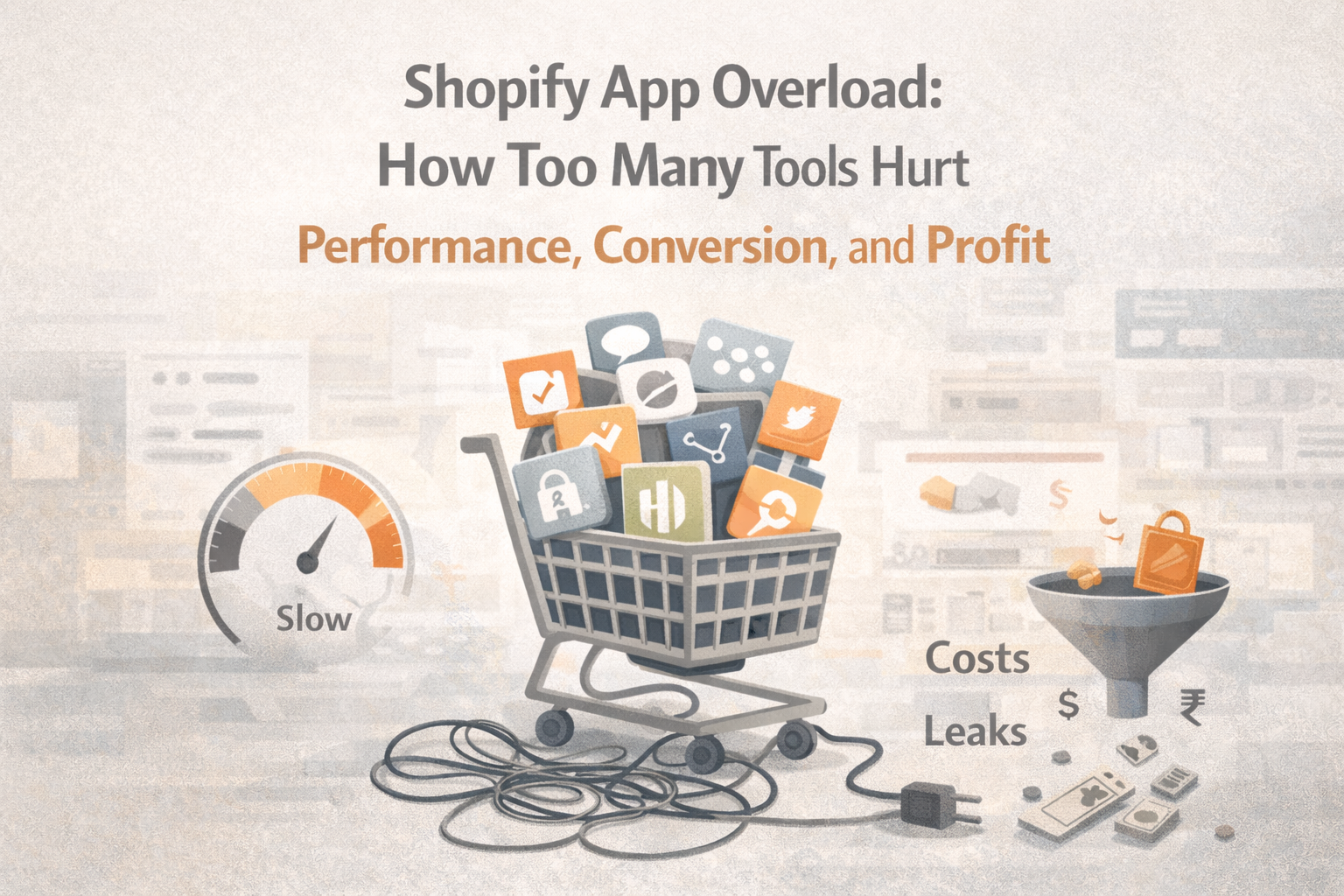
At some point, every Shopify merchant reaches the same moment.
Your store is live. Orders are coming in. And every time you hit a problem, the answer seems obvious.
“Just install an app.”
Need upsells? App. Need reviews? App. Need bundles, popups, analytics, tracking, emails, speed fixes? App, app, app.
Before you know it, your store has fifteen or twenty apps running.
And things start to feel slower, more expensive, and harder to manage.
This is what app overload looks like in real life.
Why Shopify App Overload Happens So Easily
Shopify makes it easy to add apps. That is one of its biggest strengths.
The problem is that apps solve symptoms, not systems.
Instead of stepping back and asking, “What is the core issue?”, most merchants add a tool for each new need.
Over time, the store becomes a patchwork of features that were never designed to work together.
No single app feels harmful. The damage happens in combination.
The First Cost: Store Speed and Performance
Every app adds something to your store.
- Scripts.
- Tracking pixels.
- Background processes.
- Extra requests on page load.
Individually, the impact feels small. Collectively, it adds up.
Slower load times mean:
- Higher bounce rates
- Lower conversion rates
- Worse mobile experience
- Poorer ad performance
Many merchants try to fix speed by installing a speed optimization app, which adds yet another layer.
That rarely solves the root problem.
The Second Cost: Conversion Confusion
When too many apps are running, customers feel it even if they cannot explain it.
Popups overlap. Widgets compete for attention. Messages feel inconsistent.
One app says “Limited stock”. Another says “Free shipping available”. A third pushes an upsell before the customer understands the product.
Instead of clarity, the store feels noisy.
Conversion drops not because the product is bad, but because the experience feels chaotic.
The Third Cost: Profit Leaks You Stop Noticing
Apps are not expensive individually.
₹1,500 here. ₹3,000 there. Another monthly subscription you forget about.
But when you step back and add it all up, app costs quietly eat into margins.
Many merchants discover they are spending more on apps than on hosting or even email marketing.
Worse, some apps duplicate functionality or are no longer actively used.
They stay installed simply because removing them feels risky.
The Hidden Cost: Operational Complexity
More apps means:
- More dashboards to check
- More settings to manage
- More things that can break during theme updates
- More support tickets when apps conflict
This complexity drains focus.
Instead of working on growth, merchandising, or customer experience, you spend time maintaining tools.
The store starts running you instead of the other way around.
Why More Apps Rarely Fix Core Problems
Most growth problems fall into a few buckets:
- Weak product positioning
- Low trust
- Poor traffic quality
- Confusing UX
- Inefficient checkout
Apps can support solutions, but they cannot replace thinking.
Adding an upsell app does not fix unclear product pages. Adding a popup does not fix trust issues. Adding analytics does not fix lack of insight.
Tools amplify structure. They do not create it.
How to Audit Your Shopify Apps Without Panic
You do not need to delete everything.
Start with a calm audit.
Ask these questions for each app:
- Does this app directly impact revenue, conversion, or retention?
- Is it actively used today?
- Does Shopify now offer this natively?
- Does another app already do something similar?
If an app fails all four, it is a candidate for removal.
Remove apps slowly, one at a time, and monitor impact.
Most merchants are surprised by how little breaks.
What a Healthy Shopify App Stack Looks Like
Healthy stacks are small.
They usually include:
- One core analytics tool
- One review or social proof system
- One upsell or bundling solution
- One email or retention platform
- Optional fulfillment or support tools
That is often enough.
Growth comes from how you use tools, not how many you have.
A Simple Rule to Follow Going Forward
Before installing any new app, pause and ask:
If the answer is unclear, the app will not fix it. If the answer is clear, you might still not need an app.
Final Thought for Shopify Store Owners
Apps are powerful. Too many apps are expensive.
The best Shopify stores feel calm, fast, and intentional. They do not rely on tools to create confidence. They use tools to support it.