How to Increase Average Order Value on Shopify Without Relying on Discounts
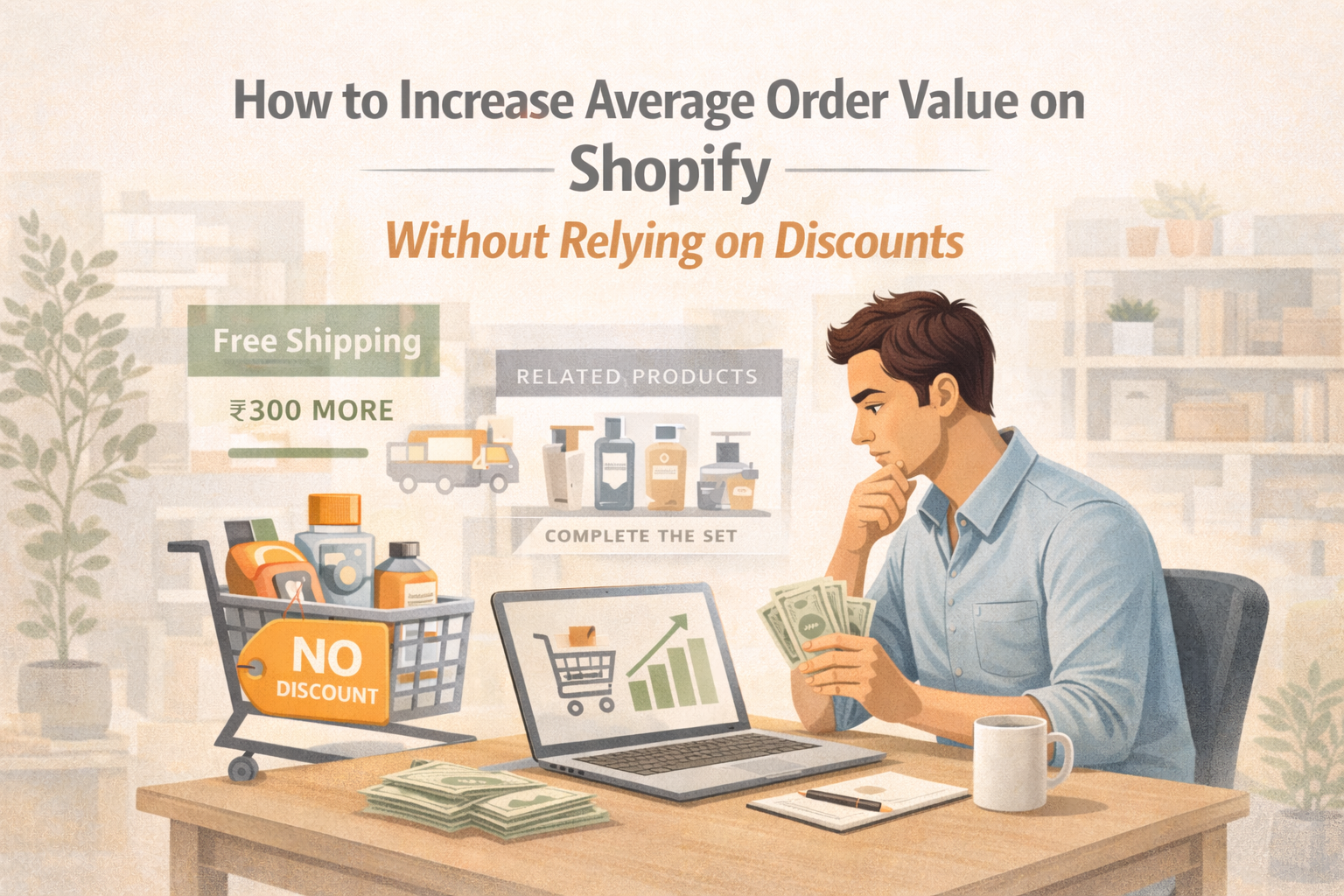
Discounts feel like the easiest lever on Shopify.
Need more revenue? Add a sale. Need more orders? Drop the price.
And for a while, it works.
Then margins shrink. Customers wait for discounts. Ads get more expensive. And suddenly your store is busy but not profitable.
If that sounds familiar, you are not doing anything wrong. You are just leaning on the only lever Shopify merchants are shown early.
The good news is this.
The most sustainable way to grow revenue is not more traffic and not deeper discounts. It is increasing Average Order Value.
And it can be done without training customers to expect a sale.
What Average Order Value Really Tells You
Average Order Value is not just a metric. It is a signal.
It tells you:
- How confident customers feel
- How well products are positioned together
- Whether your store feels like a brand or a catalog
Low AOV usually means customers are buying cautiously. High AOV means they trust you enough to commit more.
The goal is not to push people to spend more. The goal is to make spending more feel logical.
Why Discounts Are the Wrong Long Term Strategy
Discounts increase AOV temporarily, but they do three dangerous things over time.
- They train customers to wait.
- They reduce perceived value.
- They shrink margins exactly when ad costs rise.
Most stores that rely heavily on discounts hit a ceiling where growth feels harder every month.
That is why the best stores treat discounts as a tool, not a foundation.
The First Lever: Smart Bundling That Makes Sense
Bundles work when they feel helpful, not forced.
The mistake many merchants make is grouping random products just to raise the cart value.
What works instead:
- Products that are naturally used together
- One clear primary product
- One or two supporting items that reduce friction
Examples:
- Skincare plus applicator
- Device plus essential accessory
- Clothing item plus care product
The key is positioning.
Do not say “Buy more and save.” Say “Everything you need, in one go.”
That framing changes how customers think.
The Second Lever: Free Shipping Thresholds Done Right
Free shipping is one of the simplest AOV levers. It also gets misused constantly.
The difference between working and not working comes down to one thing.
Visibility.
What works:
- A clear free shipping threshold slightly above your current AOV
- A progress indicator in the cart
- Messaging that feels encouraging, not pushy
For example: “You are ₹350 away from free shipping.”
This works because it feels achievable. Customers do the math themselves.
The Third Lever: Cross Sell Where It Feels Natural
Cross sells fail when they feel like ads.
They work when they feel like advice.
The best places for cross sell:
- On the product page, below the main decision
- Inside the cart, not during checkout
- Post purchase, when trust is already earned
The rule is simple.
If the add on makes the original purchase better or easier, it belongs there. If it distracts from the main decision, it does not.
The Fourth Lever: Make the Product Feel Bigger Than the Price
Sometimes AOV is low because the product feels small.
Not physically. Perceptually.
Ways to increase perceived value:
- Better product explanations
- Clear use cases
- Showing outcomes instead of features
- Real customer examples
When customers understand what they are getting and why it matters, price becomes less sensitive.
Confidence raises AOV more than discounts ever will.
The Fifth Lever: Post Purchase Upsells That Respect the Buyer
This is one of the most underused levers on Shopify.
After checkout, the buyer has already trusted you once.
That is the moment to offer:
- A refill
- A complementary item
- An upgrade
The mistake is offering something unrelated.
Post purchase offers should feel like a continuation, not a new pitch.
What Usually Goes Wrong When Merchants Try This
They try everything at once.
Bundles, upsells, popups, apps, banners.
The store becomes noisy and confusing, and AOV stays flat.
The better approach:
- Pick one lever
- Implement it cleanly
- Measure for two weeks
- Then add the next
AOV grows through clarity, not pressure.
A Simple Way to Start Today
If you want one practical starting point, do this:
- Look at your last 100 orders
- Identify the most common product combinations
- Turn that pattern into a visible bundle or recommendation
You are not guessing. You are following customer behavior.
Final Thought From One Merchant to Another
Increasing Average Order Value is not about convincing customers to spend more.
It is about helping them buy better.
When your store feels intentional, helpful, and confident, customers naturally add more.
No discounts required.